



Private Listing Networks vs. the MLS: What Home Buyers and Sellers Need to Know
Is selling your home privately a smarter strategy, or could limiting buyer exposure cost you money?
In today's real estate market, homeowners have more choices than ever about how their properties are marketed. One approach receiving increasing attention is the use of Private Listing Networks (PLNs)—systems that allow brokerages to market homes outside traditional Multiple Listing Service (MLS) advertising channels.
Supporters argue that private networks give sellers greater control, privacy, and flexibility. Critics question whether restricting access to available homes reduces competition, limits buyer opportunities, and creates potential conflicts of interest.
Both sides raise important considerations.
After more than 30 years helping buyers and sellers throughout Fall River, South Coast Massachusetts, and Rhode Island, I believe the most important question isn't whether private listings are good or bad.
It's whether the marketing strategy truly serves the best interests of the homeowner.
Before deciding how to sell your home—or choosing an agent who promises access to exclusive listings—it's worth understanding how these systems work and what they might mean for your next real estate transaction.
What Is a Private Listing Network in Real Estate?
A Private Listing Network is a restricted system through which real estate properties are shared with a limited group of agents, buyers, or brokerage affiliates rather than being broadly advertised through the traditional MLS-connected marketplace.
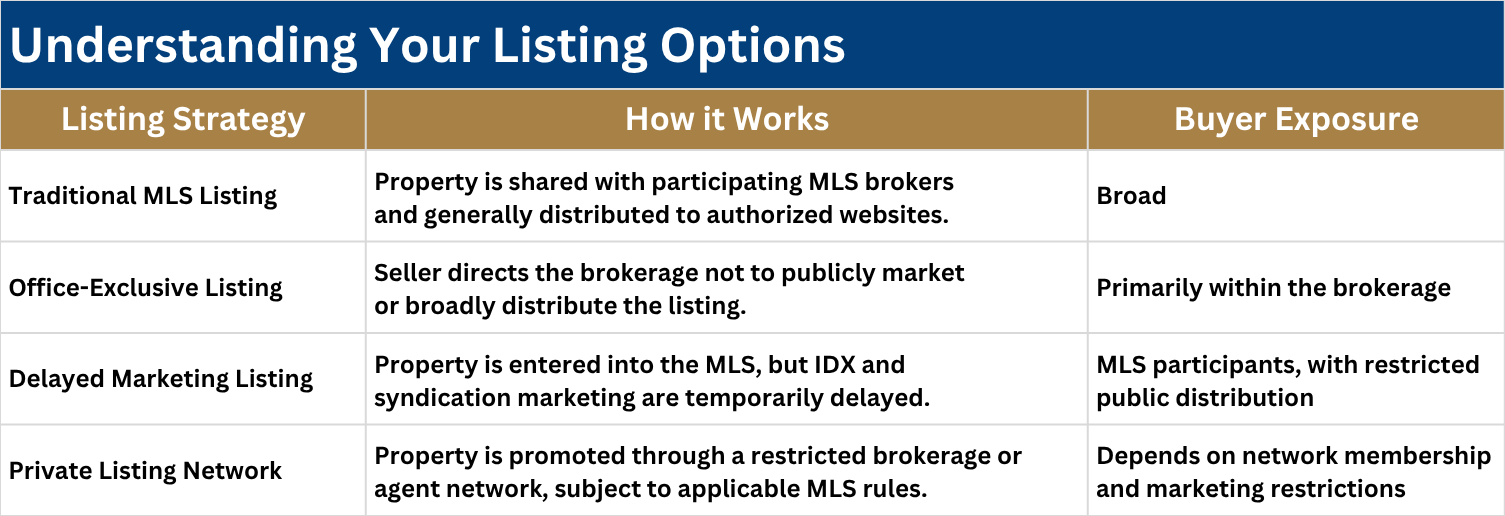
Unlike a conventional MLS listing, which is generally accessible to participating brokers and distributed through authorized real estate websites, a private listing may be available only through a particular brokerage or approved network.
These properties are sometimes described as private exclusives, pocket listings, or off-market properties, although the terms are not always interchangeable.
The key difference is buyer exposure. A traditional MLS listing is designed to encourage cooperation among participating real estate brokers, while a private listing restricts some or all of that exposure.
However, not every listing excluded from public real estate websites is truly outside the MLS.
Understanding Your Listing Options
The distinction matters because a seller may have more options than simply choosing between full public exposure and complete privacy.
For additional information, the National Association of REALTORS® Consumer Guide to Alternative Listing Options explains the choices available to homeowners.
What Are the Advantages of Selling a Home Through a Private Listing Network?
Private listings can provide meaningful benefits in certain situations. The most important advantages generally involve privacy, convenience, and control over the marketing process.
1. Greater Privacy for Homeowners
Some homeowners have legitimate reasons for not wanting their property publicly advertised.
These circumstances might involve a divorce, estate settlement, personal security concerns, tenants, or a desire to keep financial decisions private.
For these sellers, limiting exposure may be more important than reaching the largest possible buyer audience.
2. More Control Over the Selling Timeline
A homeowner may want to explore selling while preparing for a relocation, completing renovations, or deciding when to purchase another property.
A restricted marketing approach may allow them to evaluate potential buyer interest before committing to broader marketing.
However, preliminary feedback from a limited audience may not accurately reflect what the entire market would pay.
3. Fewer Showings and Less Disruption
Selling a home can be inconvenient, particularly when the property is occupied.
A smaller number of qualified buyer appointments may reduce interruptions and make the selling process more manageable.
4. Access to Buyers Already Working With the Brokerage
An established brokerage may have qualified buyers actively searching for a home that closely matches a seller's property.
Introducing those buyers before a full public launch can sometimes produce an acceptable offer without an extensive marketing campaign.
Chris's Insight: Convenience Has Value, but So Does Competition
Throughout my career, I've worked with homeowners whose priorities extend beyond achieving the highest possible sales price.
Some want privacy. Others need flexibility, certainty, or a convenient closing.
Those priorities matter.
But I also believe sellers should understand what they're giving up before choosing a strategy that limits the number of buyers who can see their home.
A convenient sale can be a successful sale. The important thing is making that decision with a clear understanding of the alternatives.
What Are the Disadvantages of Private Listing Networks for Home Sellers?
Although private marketing can offer advantages, restricting exposure introduces several potential risks.
1. Fewer Buyers May See Your Home
When a home is listed through the MLS and authorized for public distribution, it can appear on brokerage websites, home-search portals, and property alerts sent by participating buyer agents.
A private listing may not reach those audiences.
This matters because the buyer willing to offer the best price or terms may not be represented by the brokerage controlling the listing.
2. Reduced Competition Could Affect Your Sales Price
Real estate prices are influenced by supply, demand, property condition, location, and buyer competition.
When several interested buyers have the opportunity to evaluate the same property, sellers may benefit from competing offers or stronger negotiating terms.
Restricting the buyer pool can reduce those opportunities.
This doesn't mean every privately marketed property sells for less. Some private transactions produce excellent results.
It means sellers should be cautious about assuming that an offer received from a limited audience represents the strongest offer the broader market could produce.
3. Potential Conflicts of Interest
An important concern involves the relationship between the brokerage's financial interests and the seller's objectives.
A brokerage controlling both the listing and access to prospective buyers may have an opportunity to represent both sides of a transaction, where permitted by state law and with required consent.
That arrangement may provide business benefits to the brokerage.
But a seller should reasonably ask whether limiting the property's exposure is being recommended because it serves the seller—or because it helps the brokerage retain more business.
These interests aren't automatically in conflict. The possibility of competing incentives simply makes disclosure and informed consent especially important.
4. Less Transparency About Market Demand
Broad MLS marketing gives sellers access to feedback from numerous buyers and real estate professionals.
That information can help evaluate pricing, property condition, presentation, and negotiating strategy.
Private marketing generally produces feedback from a smaller audience, making it harder to determine whether the asking price and terms have been fully tested.
Do Private Listings Sell for More or Less Than MLS Listings?
Research has produced differing conclusions, which is one reason homeowners should be careful about broad claims.
In September 2026, the Association of Real Estate License Law Officials (ARELLO) released research examining more than 10 million residential transactions from January 2024 through June 2026.
The study found an association between private listings and lower sale prices relative to comparable MLS transactions. It also reported stronger relative price performance among properties marketed as Coming Soon listings.
However, the findings do not establish that private marketing itself caused those differences.
Meanwhile, a July 2026 study published by Compass reported that homes using its phased private-exclusive or Coming Soon marketing strategy sold for an average of 4.6% more than properties that went directly to the MLS, after the company's statistical adjustments.
These studies measure different property groups and marketing strategies. The Compass analysis also came from a brokerage with a business interest in private marketing.
The lesson isn't that one strategy always produces a higher price. It's that sellers should ask for evidence relevant to their property and local market rather than rely on national marketing claims.
A Practical Example
Imagine a homeowner in Westport, Massachusetts, considering a sale at $650,000.
Through private marketing, the seller receives an offer of $640,000 from a qualified buyer with attractive terms.
That might be an excellent outcome.
But what if broader MLS exposure attracted several additional buyers, including one willing to pay $665,000 with comparable terms?
The difference would be $25,000.
These figures are hypothetical and do not predict what would happen in an actual Westport transaction.
The question is whether the homeowner had enough information to make a confident decision about accepting a private offer instead of testing the larger market.
What Do Private Listing Networks Mean for Home Buyers?
Private listing systems also affect buyers, particularly those already facing limited inventory and competition.
Potential Advantages for Buyers
A buyer connected to a brokerage with private inventory may learn about certain properties before they are broadly advertised.
This could create opportunities to view homes earlier or negotiate without competing against as many purchasers.
For some buyers, access to a suitable property may be more valuable than having every listing available on the same public platform.
Potential Disadvantages for Buyers
The biggest concern is unequal access to housing opportunities.
Consider two qualified buyers searching for similar homes in Somerset or Tiverton.
One works with a brokerage operating a private listing network. The other works with an independent agent outside that network.
If suitable homes are circulated exclusively within the first brokerage, the second buyer may never have an opportunity to consider them.
Over time, widespread use of private networks could make it harder for buyers to conduct a comprehensive home search through one trusted real estate professional.
Buyers might feel pressured to establish relationships with multiple companies simply to learn about available inventory.
Chris's Insight: Your Choice of Agent Should Be About Representation
I've always believed buyers should choose their real estate professional based on trust, experience, local knowledge, and the quality of representation they receive.
They shouldn't have to wonder whether choosing one brokerage means losing access to homes controlled by another.
A cooperative marketplace helps buyers evaluate more opportunities while working with an agent who understands their priorities.
That's particularly important for first-time buyers, relocating families, and downsizing homeowners who may already be navigating unfamiliar decisions.
If you're planning a purchase, our Home Buyer's Road Map explains important steps in the buying process and how to prepare for a successful search. And its companion Home Buyer Workbook has all the worksheets, checklists and planning tools you'll need for a smooth stress-free home buying experience.
Who Benefits When a Brokerage Controls Its Own Private Listing Network?
This is one of the most important questions in the current industry discussion.
Large brokerages can develop substantial networks of agents, buyers, and sellers. A private listing system may help them attract more business by providing inventory that competing brokerages cannot access as easily.
For these companies, exclusive inventory may become an agent recruiting advantage and a reason for buyers to use their services.
There is nothing inherently wrong with a brokerage developing tools or services that benefit its customers.
But the real estate marketplace works best when business strategies remain aligned with consumers' interests.
If private networks become widespread, buyers could experience a more fragmented market, and sellers could have fewer opportunities to reach interested purchasers.
Independent brokerages may also face greater difficulty competing for clients when access to properties becomes concentrated within large organizations.
Ultimately, this raises a broader issue:
Should access to available homes depend on the brokerage a consumer chooses, or should qualified buyers and their agents have a reasonable opportunity to participate in the marketplace?
Are Private Listings Allowed in Massachusetts and Rhode Island?
Private listings are not automatically prohibited, but they must comply with applicable state laws and MLS policies.
Massachusetts: MLS PIN
In southeastern Massachusetts, many real estate professionals participate in MLS Property Information Network, commonly known as MLS PIN.
MLS PIN's rules include procedures governing office-exclusive listings, delayed listings, and Coming Soon listings.
For example, its office-exclusive procedure requires the seller to initiate the decision not to place the property in the MLS and execute the applicable Non-MLS Listing Form. The required form must be submitted according to MLS PIN's rules.
This is not simply an option an agent should select without discussing the consequences with the seller.
Review the MLS PIN Rules and Regulations for current requirements.
Rhode Island: State-Wide MLS
Rhode Island State-Wide MLS also maintains rules governing Non-MLS, Coming Soon, and publicly marketed listings.
In May 2026, State-Wide MLS expanded distribution options for Coming Soon listings through IDX, virtual office websites, and third-party data feeds, depending on the listing's selected distribution settings.
These options can provide sellers with additional marketing flexibility while retaining the benefits of MLS participation.
Rhode Island's Clear Cooperation guidance also addresses private networks that include agents from multiple brokerages. Marketing through those networks may trigger MLS submission requirements.
See the Rhode Island State-Wide MLS Rules and Policies and Coming Soon policy update.
What Is the MLS Clear Cooperation Policy?
The National Association of REALTORS® Clear Cooperation Policy generally requires participating brokers to submit a listing to the MLS within one business day after publicly marketing the property.
In March 2025, NAR introduced its Multiple Listing Options for Sellers policy, which added a delayed-marketing option while retaining the underlying Clear Cooperation requirements.
Under the national policy, certain seller-authorized listings can be entered into the MLS while public distribution through IDX and syndication is delayed for a period determined by the local MLS.
A delayed-marketing listing is still available to participating MLS professionals.
An office-exclusive listing, by contrast, is not broadly disseminated to other MLS participants.
The rules are important because a private network is not necessarily exempt from MLS submission requirements simply because it calls itself private.
Local rules and required seller disclosures must always be reviewed before adopting a restricted marketing strategy.
Six Questions Every Home Seller Should Ask Before Choosing a Private Listing
Before agreeing to limited marketing, I encourage homeowners to ask their real estate professional these questions:
1) Who will actually see my home? Will it be available to all MLS participants, only agents within one company, or a selected buyer network?
2) What exposure am I giving up? Which real estate websites, buyer alerts, and cooperating agents will not receive the listing?
3) How could this decision affect my sales price? Is there credible local evidence supporting the recommendation?
4) Does the brokerage benefit financially from keeping the listing private? How will any potential conflicts of interest be disclosed and managed?
5) Can I change my mind? What happens if I want broader marketing after reviewing initial buyer interest?
6) What is our plan if the property doesn't sell? When will we reassess price, presentation, and market exposure?
These questions aren't meant to discourage private listings.
They're intended to help homeowners make informed decisions.
Chris's Insight: The Best Marketing Strategy Begins With the Seller, Not the Brokerage
After more than three decades in real estate, I've learned that no two homeowners approach selling with exactly the same priorities.
Some sellers want maximum exposure and the strongest possible price.
Others place greater importance on privacy, convenience, timing, or certainty.
A professional real estate advisor should understand those priorities before recommending a marketing strategy.
I also believe that cooperation among real estate professionals has been one of the MLS system's greatest strengths.
Sharing listings creates opportunities for buyers, encourages competition, and helps sellers reach people they might otherwise miss.
For that reason, I generally favor broad MLS exposure when a homeowner's goal is to reach the largest practical pool of qualified buyers.
However, I recognize that private marketing can be appropriate when a seller has a legitimate reason for limiting exposure and fully understands the tradeoffs.
My guiding principle is simple: The marketing strategy should fit the seller's objectives—not the brokerage's business model.
Frequently Asked Questions About Private Listing Networks
1. What is the difference between a private listing and an MLS listing?
An MLS listing is generally shared with participating real estate brokers and may be distributed through authorized public websites. A private listing limits access to a particular brokerage or network. Some listings are entered into the MLS but temporarily withheld from public IDX distribution.
2. Do private listings sell for more money?
Not necessarily. Some private listings produce strong offers, but limiting exposure may reduce buyer competition. Research findings vary by study and marketing method. Sellers should review relevant local market evidence before assuming either approach will produce a higher price.
3. Can I sell my house without putting it on the MLS?
Yes, certain seller-directed office-exclusive or Non-MLS arrangements may be permitted. However, applicable MLS rules, disclosure requirements, and restrictions on public marketing must be followed. Your broker should explain the options before you decide.
4. What is IDX in real estate?
IDX stands for Internet Data Exchange. It is a system that allows participating real estate brokers to display eligible MLS listings on their websites under applicable MLS rules. IDX helps consumers search listings from multiple participating brokerages.
5. Are private listing networks fair to home buyers?
Private listings can provide legitimate seller benefits, but restricted distribution may limit buyer access. Fair housing concerns may arise if marketing methods disproportionately exclude certain groups. Brokerages must comply with fair housing laws regardless of how properties are marketed.
6. Should I list my home privately or through the MLS?
The right choice depends on your priorities. If broad buyer exposure and competition are important, traditional MLS marketing generally provides the widest reach. If privacy or another specific concern is more important, restricted marketing may be worth considering after reviewing the tradeoffs.
Final Thoughts: The Right Way to Sell Your Home Is the Way That Serves Your Goals
The growing discussion surrounding private listing networks is likely to continue as brokerages, technology platforms, and MLS organizations reconsider how homes are marketed.
For consumers, the most important issue is not which organization wins that debate.
It's having access to clear information, meaningful choices, and professional advice that puts their interests first.
If you're preparing to sell a home in Fall River, Westport, Somerset, Swansea, Dartmouth, New Bedford, or nearby Rhode Island communities, I encourage you to understand your marketing options before making a commitment.
A successful sale starts with the right strategy—not simply placing a property on the market.
Thinking About Selling Your Home?
At E Z Home Search Real Estate, we believe homeowners deserve a personalized marketing strategy built around their goals, property, and local market conditions.
Whether you're planning to sell soon or simply exploring your options, I'm happy to help you understand the opportunities and tradeoffs.
Helpful Resources
Call or Text Chris: 774-930-4595
Visit EZHomeSearch.net
When the time is right, let's do business. In between, let's do life.
About Christopher Terry
Christopher Terry is the Broker/Owner of E Z Home Search Real Estate Inc. and a licensed real estate broker in Massachusetts and Rhode Island.
With more than 30 years of experience, Chris specializes in helping first-time buyers, move-up buyers, downsizing homeowners, and sellers throughout Greater Fall River, South Coast Massachusetts, and Rhode Island.
His approach is built around education, local expertise, personalized guidance, and lasting relationships.
E Z Home Search Real Estate Inc. — Service for Life
Editor's note: This article provides general educational information, not legal advice. MLS policies and local requirements may change, and individual transactions should be evaluated under the applicable rules.
Check out this article next