
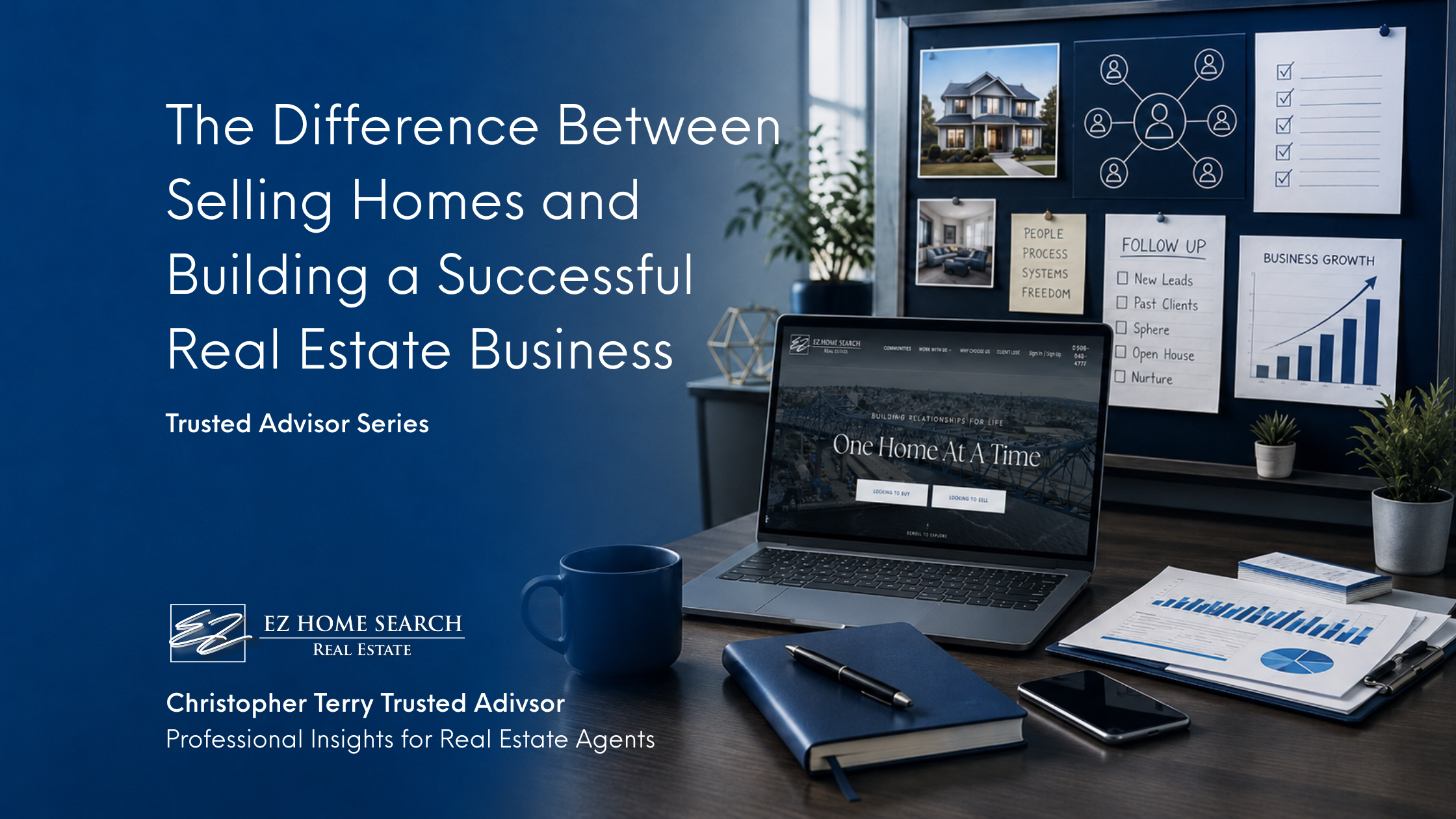
The Difference Between Selling Homes and Building a Real Estate Business
Selling a home can produce a commission. Building a business can produce the next client before you need one.
There is a point in almost every real estate agent’s career when this distinction becomes important.
Early in the business, success often feels pretty simple:
Find a buyer.
Get a listing.
Put a deal together.
Get to closing.
Get paid.
Then start over.
There is nothing wrong with that. Transactions are how we earn a living.
But after enough years in real estate, an important question starts to emerge:
Am I simply selling homes—or am I actually building a business?
Those are not the same thing.
And understanding the difference may be one of the most important steps an agent can take toward creating a more predictable, sustainable real estate career.
Selling Homes Creates Income. Building a Business Creates Momentum.
A real estate transaction has a beginning and an end.
You meet the client.
You help them buy or sell.
You navigate inspections, financing, negotiations, paperwork and closing.
Then the transaction ends.
If your relationship with that client ends at the closing table too, your business essentially resets to zero.
You need another lead.
Another buyer.
Another listing.
Another transaction.
That creates what I call the transaction treadmill.
You're constantly moving, but you never seem to get far enough ahead.
Building a business works differently.
A business asks:
What happens after the closing?
How do I stay connected with this client?
How do I remain useful to them?
How do I become the person they think of when a friend says, “We're thinking about moving.”
How do I create enough value that five years from now they still consider me their real estate professional?
That is when real estate begins changing from a series of transactions into a business.
And the numbers show why that distinction matters.
According to the National Association of REALTORS®, REALTORS® typically generated 20% of their business from repeat clients and another 21% from referrals from past clients and customers in its 2025 Member Profile.
That means relationships aren't simply a nice addition to your business.
They can become one of its foundations.
A Business Has a System for Finding the Next Client
One of the biggest vulnerabilities I see in real estate is dependency.
An agent becomes dependent on internet leads.
Or portal leads.
Or brokerage leads.
Or relocation leads.
Or referral companies that may take a substantial portion of the commission when a transaction closes.
Those sources can certainly produce business.
The problem begins when they become the only way the agent knows how to create business.
Because when the leads stop, the business stops.
That's not really a business.
That's a dependency.
The National Association of REALTORS® identifies networking, prospecting, farming, repeat business and referrals as important methods for maintaining a pipeline of potential clients.
An agent building a business therefore needs a repeatable answer to a very basic question:
Where will my next five clients come from?
Not someday.
Not hopefully.
Not if Zillow sends another lead.
Where are they likely to come from?
That is why I believe one of the greatest assets an agent can develop is their sphere of influence.
The people who already know you.
The people who already trust you.
Past clients.
Friends.
Family.
Neighbors.
Former coworkers.
Business owners.
Community connections.
People you've helped but who haven't needed to buy or sell yet.
At E Z Home Search, we've built our Sphere of Influence and Referral Lead Generator systems around this idea.
The objective isn't to turn every conversation into a sales pitch.
It's almost the opposite.
The objective is to create a disciplined system for maintaining genuine relationships so that when real estate eventually becomes part of someone's life, you're already someone they know and trust.
A Business Doesn't Rely on Memory
Here's another difference.
Someone selling homes often keeps the business in their head.
They remember they should call someone.
They think they should follow up with an old client.
They make a mental note to send an email.
They intend to contact a lead next week.
Then real estate happens.
An inspection problem appears.
A lender needs something.
A listing appointment gets scheduled.
An appraisal comes in.
Three offers arrive.
And suddenly that follow-up that was supposed to happen Tuesday gets forgotten.
That's why businesses need systems.
The U.S. Small Business Administration emphasizes business planning, financial management and organized day-to-day operations as fundamental parts of running and growing a business.
Real estate shouldn't be different.
You need systems for:
- Lead generation
- Contact management
- Follow-up
- Buyer consultation
- Listing preparation
- Transaction management
- Client communication
- Marketing
- Past-client relationships
- Referrals
- Financial management
The goal isn't to create bureaucracy.
The goal is to create consistency.
Because once something important depends entirely on whether you happen to remember it, you don't really have a system.
Your Transaction Process Is Part of Your Business
Sometimes agents think “building a business” means marketing.
Marketing matters.
But operations matter just as much.
Think about everything that happens between meeting a client and reaching the closing table.
Agency disclosures.
Buyer agreements.
Listing agreements.
Offers.
Inspections.
Mortgage contingencies.
Attorney communication.
Final walkthroughs.
Closing documents.
Commission statements.
File requirements.
Deadlines.
Compliance.
A professional business shouldn't reinvent those processes every time another property goes under agreement.
That's why E Z Home Search maintains separate Buyer-Side Transaction and Listing-Side Best Practices processes.
Our buyer process follows the transaction from the initial agency relationship through offers, inspections, mortgage commitment, final walkthrough and closing.
Our listing process does the same from the listing paperwork and MLS preparation through offers, inspections, the purchase-and-sale agreement, closing preparation and final documentation.
Why?
Because systems reduce the number of important things that depend solely on memory.
They also allow an agent to spend more time doing something technology and checklists cannot replace:
advising the client.
Your Database May Be More Valuable Than Your Next Lead
Agents naturally get excited about new leads.
I understand why.
New leads represent possibility.
But there's another question worth asking:
How much opportunity is sitting inside the relationships you already have?
One of my concerns about the modern lead-generation environment is that agents can become so focused on finding strangers that they overlook people who already know them.
The agent buys another lead.
Runs another advertisement.
Signs up for another platform.
Pays another referral fee.
Meanwhile, somebody they helped six years ago sells their house with another agent simply because nobody stayed in touch.
That's not really a lead-generation problem.
That's a relationship-management problem.
Your database shouldn't simply be a collection of names.
It should be the foundation of a long-term relationship system.
That means staying in touch when somebody isn't buying or selling.
Providing useful information.
Checking in.
Sending market information when it matters.
Offering an annual equity review.
Sharing something helpful about homeownership.
Providing a newsletter people actually want to read.
Remembering that the relationship is bigger than the transaction.
That's the thinking behind our Service for Life philosophy.
The transaction may last a few months.
The relationship could last decades.
Your Personal Brand Matters More Than Your Brokerage Logo
There is another uncomfortable truth agents eventually discover:
Most consumers don't hire you because of the logo on your business card.
They hire you.
Your knowledge.
Your responsiveness.
Your reputation.
Your communication.
Your local expertise.
Your ability to solve problems.
Your ability to make complicated situations understandable.
Your ability to earn trust.
That's why one of the principles behind E Z Home Search is that agents should understand that they are building their own professional brand within the brokerage.
A brokerage brand should support that.
It shouldn't replace it.
Your brokerage should provide the infrastructure behind your business while helping you become more recognizable in your own market.
That can include technology.
Web presence.
IDX.
Content.
Marketing tools.
Transaction systems.
Education.
Broker support.
Professional standards.
At E Z Home Search, for example, agents have access to resources including Remine Docs+ for forms and transaction management and RPR for property data, market information and prospecting tools.
But technology isn't the business either.
Technology simply supports the business.
The business is still built around relationships, knowledge, professionalism and consistent execution. That is also why I believe professional real estate agents will win the next decade. As technology makes information easier to access, the agent's real value increasingly comes from judgment, communication, expertise and the ability to guide clients through decisions.
A Business Tracks More Than Closings
Ask many agents how their year is going and the first answer will usually be:
“I've closed ___ transactions.”
That's important.
But someone building a business should know more than their closed sales.
For example:
How many people are in your sphere?
How many meaningful conversations are you having?
How many past clients have you contacted?
How many referrals have you received?
Where did your last ten transactions originate?
How many people receive your newsletter?
How many contacts were added to your database this month?
What percentage of your business comes from repeat clients?
What percentage comes from referrals?
Which lead sources actually make money after expenses and referral fees?
Which marketing activities are producing relationships rather than clicks?
Those numbers tell you something your closing count alone cannot.
They tell you whether the business underneath the transactions is becoming stronger.
The Goal Isn't to Work More. It's to Build Better.
There is a dangerous assumption in real estate:
If business is slow, work harder.
Sometimes that's exactly what is required.
But sometimes the better question is:
What should I build so I don't have to keep solving the same problem?
If follow-up is inconsistent, build a follow-up system.
If leads are unpredictable, build your sphere.
If nobody remembers you after closing, create a past-client system.
If your marketing is inconsistent, build a content calendar.
If transactions feel chaotic, use a transaction process.
If you're repeatedly answering the same client questions, create educational resources.
If all your knowledge lives inside your head, document it.
That's how an individual agent gradually develops something more valuable than another closing.
They develop infrastructure.
The Best Real Estate Businesses Compound
There is a point where years in real estate should begin working in your favor.
Consider two agents who each close ten transactions this year.
Agent A completes the ten transactions and starts next year looking for ten more people.
Agent B completes the same ten transactions but adds those clients to a relationship system.
They stay in touch.
They provide useful information.
They ask for introductions appropriately.
They continue helping after closing.
Those ten relationships become part of the foundation for next year.
Then the next ten get added.
Then another ten.
Year after year, the business becomes deeper.
The agent's reputation becomes stronger.
Their database becomes larger.
Their referral network becomes more productive.
Their local knowledge becomes more valuable.
Their content library grows.
Their systems improve.
Their business begins to compound.
That is a very different career from endlessly chasing the next transaction.
Recent NAR research reinforces the importance of that foundation. In its 2025 Profile of Real Estate Firms, NAR reported that firms were leaning heavily on repeat clients, referrals, training and technology as they navigated a challenging housing environment.
And in its 2026 Member Profile reporting, NAR described experienced professionals as relying on referrals, repeat clients and deep market knowledge to navigate a difficult market.
That shouldn't be surprising.
Markets change.
Relationships and professional skill travel with you through those changes.
Your Brokerage Should Help You Build the Business
This brings us to something agents don't always think about when choosing a brokerage. As I discussed in The Brokerage You Choose Matters More Than Ever, the company you affiliate with should be evaluated on much more than a commission split or familiar name. The bigger question is whether the brokerage helps you become a stronger, more capable real estate professional.
Don't only ask:
“What's the commission split?”
That's certainly part of the decision.
But also ask:
“Will this brokerage help me build something?”
Will you become better at generating your own opportunities?
Will you have systems you can follow?
Will someone help when a transaction gets complicated?
Will you learn how to strengthen your sphere?
Will you have tools that support your personal brand?
Will you have a process for staying connected after closing?
Will you understand where your business is actually coming from?
Will you become less dependent on buying leads?
And perhaps most importantly:
Will you be a stronger real estate professional five years from now because of what you're learning today?
At E Z Home Search, our operating philosophy is that buyers and sellers are best served when associates use a professional, consistent approach to the business. Our policy manual is designed as a reference for how the company operates while encouraging agents to improve procedures and contribute ideas.
That same philosophy applies to agent development.
The brokerage shouldn't build your business for you.
But it should help provide the tools, systems, education and support that make building one easier.
Selling Homes vs. Building a Business
Here's the simplest way I can explain the difference.
Selling homes asks:
Where is my next transaction?
Building a business asks:
What system consistently creates future opportunities?
Selling homes asks:
How many deals did I close?
Building a business asks:
How many relationships did I strengthen?
Selling homes asks:
How do I get another lead?
Building a business asks:
How do I create a dependable pipeline?
Selling homes focuses on the closing.
Building a business focuses on what happens before, during and long after the closing.
And here's the important part:
You don't have to choose between being a good salesperson and being a good businessperson.
You need both.
Transactions produce today's income.
Systems, relationships and reputation create tomorrow's opportunities.
A Question Worth Asking Yourself
If you've been in real estate for several years, take an honest look at your business.
If you stopped buying leads tomorrow…
If your favorite lead source disappeared…
If the market slowed…
If your brokerage stopped handing you opportunities…
Would you still know where your next clients were going to come from?
If the answer makes you uncomfortable, that's not a reason to panic.
It's a reason to start building.
Build your sphere.
Build your database.
Build your follow-up system.
Build your personal brand.
Build your knowledge.
Build your client experience.
Build your referral network.
Build processes that don't disappear when one transaction closes.
Because the goal shouldn't simply be to sell another house.
The goal should be to build a real estate business capable of producing opportunities for years to come.
Thinking About What Your Real Estate Business Could Look Like?
At E Z Home Search Real Estate, I believe agents should become increasingly capable of generating their own business—not increasingly dependent on someone else supplying it.
We focus on practical systems, professional standards, technology, transaction support, relationship marketing and helping agents develop the skills to create long-term opportunities.
You don't need another recruiting pitch.
Sometimes you simply need a conversation about where your business is today, where you want it to go, and what's standing between the two.
If you'd like to explore what's possible, let's have a conversation.
Learn more about E Z Home Search Real Estate at EZHomeSearch.net/join-us.
When the time is right, let's do business. In between, let's do life.
About the Author
Christopher Terry is the Broker/Owner of E Z Home Search Real Estate Inc., serving South Coast Massachusetts and Rhode Island. With more than 30 years of real estate experience, Chris has worked with buyers, sellers, investors, and real estate professionals through changing markets, technologies, and business models.
His approach is centered on education, professional systems, local expertise, and helping agents build sustainable businesses based on relationships, reputation, and long-term client service.
Chris believes the strongest real estate careers are built by becoming a trusted advisor, not simply by chasing the next transaction.
Frequently Asked Questions
What does it mean to build a real estate business?
Building a real estate business means creating repeatable systems for lead generation, client service, follow-up, marketing, referrals and operations rather than relying exclusively on finding one transaction at a time.
How can a real estate agent create more predictable business?
Start by understanding where your existing business originates. Build and maintain a database, systematically communicate with your sphere and past clients, develop referral relationships, maintain consistent marketing and track which activities actually produce clients.
Why is a sphere of influence important for real estate agents?
Your sphere includes people who already know or have a connection with you. Maintaining those relationships can create repeat and referral opportunities over time. NAR's 2025 Member Profile found that REALTORS® typically generated substantial portions of their business from repeat clients and referrals from past clients.
Should real estate agents buy leads?
Purchased leads can be one component of a lead-generation strategy, but depending entirely on purchased leads creates vulnerability. A stronger business develops multiple sources of opportunity, including sphere relationships, referrals, past clients, community presence, prospecting and marketing.
What should a brokerage provide an experienced agent?
Beyond compensation, an agent should evaluate broker accessibility, transaction support, professional standards, technology, marketing resources, training, systems and whether the brokerage helps the agent become more capable of creating and managing their own business.
Is personal branding important for real estate agents?
Yes. Consumers ultimately experience the individual professional—their knowledge, communication, service and reputation. A brokerage can strengthen that positioning by providing technology, systems, brand credibility and support while allowing the agent to develop their own professional identity.
Check out this article next